Why this history matters
Its history also contains an extraordinary legal episode: a court-appointed receiver kept the business operating while its owners’ property was under federal control. That was the consequence of a private dispute, not a government decision to enter the casino industry. Understanding how it happened reveals the fragile economics behind the establishment’s crowded dance floor.
A silver town creates a market for nightlife
Tonopah developed around the silver discovery credited to Jim Butler in 1900. Mines drew workers and investment, and businesses followed: hotels, banks, saloons, restaurants, and places of entertainment. In 1905 the town became the Nye County seat, replacing Belmont.
The Big Casino opened during this early boom. Local histories place its beginning in late 1904 or April 1905, while a collector catalog gives an earlier date. The precise opening should therefore remain qualified. What is clear is that the establishment was part of the boom-era town, long before Nevada’s modern resort industry.
Its location was on the east side of Main Street between Oddie and Knapp avenues, in the lower downtown district. It was separate from the Tonopah Club. Later associations with operator Nick Abelman connect the two businesses through a person, but do not make them one building or one operation.
Inside the dance hall
The Big Casino combined a restaurant, saloon, gambling space, and dance hall. Musician Joe Andre’s later recollections describe a bar and three gambling tables near the entrance, a maple dance floor, an oak railing, and a stage for the band. Booths with doors offered privacy along one side, while rooms overlooked the floor from a balcony.
This is an unusually tangible description of a mining-town entertainment establishment. It is also a remembered interior, not an architectural survey or a gaming-license inventory. The three-table detail belongs to the scene Andre described and should not be treated as the casino’s fixed capacity throughout its existence.
The dance-hall business included women paid through commissions on drinks and dancing. Andre recalled fifty-cent drinks, with half going to the woman, and variable charges for dances. He also described drinks for the women being made with colored water. These details come from oral history and cannot be assumed to describe every customer or every period.
Rooms associated with prostitution formed another part of the operation. That commercial activity should be acknowledged without collapsing all performers, dancers, workers, and patrons into a single category. The establishment contained several overlapping businesses, and the surviving accounts do not provide a complete record of the women’s working conditions or individual lives.
An orchestra and news from distant racetracks
The casino employed professional musicians, including an orchestra associated with Jules Goldsmith. Performers came from cities such as Reno and San Francisco, bringing a wider entertainment circuit into the mining town. Andre remembered the Big Casino as having Tonopah’s largest band.
In his account, a normal evening’s music ran from about eight until one, but a busy room could keep musicians working until sunrise. Other historical descriptions recall musicians playing outside to announce the evening’s opening. These were practical ways to draw customers into a business dependent on sustained activity.
By 1907, historical accounts describe direct wires bringing information from major racetracks. Such connections allowed customers in Tonopah to follow and wager on events taking place far away. The Big Casino therefore illustrates an early link between communications technology and Nevada betting, decades before the familiar modern race and sports book.
The 1907 Gans–Herman championship fight
On January 1, 1907, Joe Gans fought Kid Herman, also known as Herman Landfield, in Tonopah for the world lightweight championship. Gans won by knockout in the eighth round. The event drew attention well beyond the town and connected its gambling economy with major professional sport.
The fight is associated with the Casino Athletic Club arena, and the Big Casino participated in the surrounding promotion. It should not be described as a contest staged in an ordinary room of the dance hall. A 1908 Nevada Supreme Court case identifies the Casino Athletic Club partnership and lumber supplied for a fight arena, supporting a distinction between the event venue and the main establishment.
The Miles Brothers filmed the contest. Film catalog records describe a three-reel production released in January 1907, including material beyond the fight itself. The existence of a catalog entry establishes a historical production, not that a usable print survives or that footage of the Big Casino building appears in it.
Why a federal receiver ran the business
Nevada’s anti-gambling law took effect on October 1, 1910, weakening a central part of the Big Casino’s business. Financial and legal trouble followed. By 1913, William S. Johnson and G. W. Summerfield are identified in the historical reconstruction as its owners.
The receivership arose from a dispute involving Johnson and his former wife, Roxa. She challenged their divorce settlement and the represented value of his estate. The court placed assets under control while the dispute proceeded; the casino was among those assets.
In August 1913, Judge W. W. Morrow appointed Bonneau as receiver. The business continued operating under that court-supervised arrangement, with Joe Monahan identified as managing its gambling activity. Accounts of the episode describe a profitable period, despite the state’s restrictions on gambling.
The striking phrase that the federal government operated a casino or brothel needs this explanation. A receiver was preserving and administering disputed private property. The episode was neither an ordinary federal enterprise nor a new policy authorizing Nevada gambling.
Nye County commissioners revoked the liquor license in November 1913 and declared the operation a public nuisance. Losing liquor sales damaged the business sharply, and the receiver closed it. A historical reconstruction reports a later reopening under Charles Enquist, but its printed date contains an error; the exact reopening date is not asserted here.
A changing business, then the fire of 1922
Later photographs identify the premises as the Big Casino Hotel. Historical accounts describe a shift toward hotel use around 1920, while Andre recalled working there from April 1921 until the fire. Those accounts suggest a changing operation rather than a clean, simultaneous end to every earlier activity.
On August 23, 1922, fire swept through lower downtown Tonopah and destroyed the Big Casino along with surrounding buildings. The loss removed a major physical reminder of the town’s boom-era nightlife. Surviving interior and street photographs now carry much of the burden of showing what the place looked like.
The hotel name, the earlier dance hall, and the Athletic Club arena should remain distinct parts of the story. A name on a photograph identifies a phase of use; it does not automatically establish the same activities behind the façade in every year.
Tokens from a complicated establishment
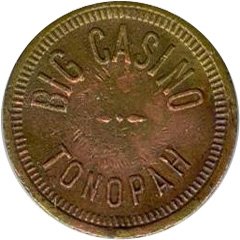
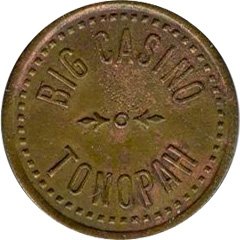
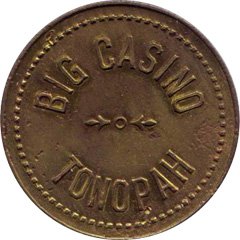
Collector records identify Big Casino tokens with five-cent, twenty-five-cent, and fifty-cent values. They are cataloged as tokens rather than confirmed table-game chips. An auction catalog also describes merchandise and brothel-token material associated with the property.
Because the establishment sold several kinds of service, a denomination alone cannot establish how a token was used. Drinks, trade credit, gambling, and other transactions require their own supporting evidence. The objects are valuable traces of the business, but their exact functions should be read from inscriptions and documentation rather than inferred from the casino name.
The Big Casino’s larger significance lies in that mixture of activities. It shows how mining wealth supported an entertainment economy, how wires connected a remote town to national events, and how changes in law and ownership could destabilize a crowded and apparently successful establishment.
The story in time
- 1900
Jim Butler’s silver discovery begins Tonopah’s mining-boom story.
- Late 1904 / 1905
Local histories place the Big Casino’s opening during this period.
- January 1, 1907
Joe Gans defeats Kid Herman at the Casino Athletic Club arena.
- January 1909
Historical accounts record incorporation of the Big Casino Company.
- October 1, 1910
Nevada’s anti-gambling law takes effect.
- 1913
A federal receivership keeps the business operating; county authorities revoke its liquor license in November.
- Around 1920
The Big Casino Hotel name marks a later phase of the premises.
- August 23, 1922
A downtown fire destroys the building.
Sources & further reading
The numbered links in each chapter point to the supporting material below. The wider bibliography also includes archival collections and specialist references. Historical uncertainty is explained where it affects the story; a source link does not grant permission to reproduce its images.
Start with these sources
Nevada State Historic Preservation Office — TonopahNye County Town History Project — Tonopah: The Greatest, the Richest, and the BestNational Register nomination — Abelman HousePahrump Valley Times — Federal government-operated Tonopah brothelNevada Historical Society Quarterly, Fall 1978BoxRec — Joe Gans vs. Kid Herman- Research sourceNevada State Historic Preservation Office — Tonopah
- Research sourceNye County Town History Project — Tonopah: The Greatest, the Richest, and the Best
- Research sourcePahrump Valley Times — Federal government-operated Tonopah brothel
- Research sourceDoresa Banning — U.S. Runs Gambling House in Nevada
- Research sourceNevada Historical Society Quarterly, Fall 1978
- Research sourceThe Billboard, September 18, 1909
- Research sourceHistoric Oregon Newspapers, January 1, 1907
- Research sourceBoxRec — Joe Gans vs. Kid Herman
- Research sourceAFI Catalog — Gans-Herman Fight
- Research sourceSilent Era — Gans-Herman Fight
- Research sourceFort Worth Telegram, January 1, 1907
- Research sourceTonopah Lumber Co. v. Riley, Nevada Supreme Court (1908)
- Research sourceNevada Historical Society Quarterly, Summer 1978
- Research sourceNew Zealand Graphic — The Fight at Tonopah
- Research sourceNye County oral history — Coombs interview
- Research sourceNational Register nomination — Abelman House
- Research sourceTown of Tonopah — historic photographs
- Research sourceHistoric Tonopah — Big Casino mural
- Research sourceChipGuide — Big Casino, Tonopah
- Research sourceChipGuide 5¢ image
- Research sourceChipGuide 25¢ image
- Research sourceChipGuide 50¢ image
- Research source2019 Western States token-auction catalog
- Research sourceUNLV finding aid for Joe Andre oral-history materials
Add to this history
Have a photograph, a document, or a first-hand memory? Help us make the record more complete.
Share a memory or correction